
I’d Choose the Sound
When bandwidth is limited, what matters most: the picture or the experience?
Imagine I am on a desert island with limited Wi-Fi. I can stream good video with crappy sound, or I can send great audio with no video at all.
Which would I choose?
Great audio. No question.
That may sound like an odd thing to say in a world where everyone seems to be carrying a video camera in their pocket. We have been trained to think that if something is not on video, it somehow did not happen. But people were moved by voices, stories and music long before we could watch everything on a screen. Radio carried people into homes and across oceans. Records built relationships between musicians and listeners who might never meet. Every band before MTV had to reach our ears before it could capture our eyes.
I love pictures. I have spent much of my life working with cameras, television, live events and production. Filming is important. But audio is key.
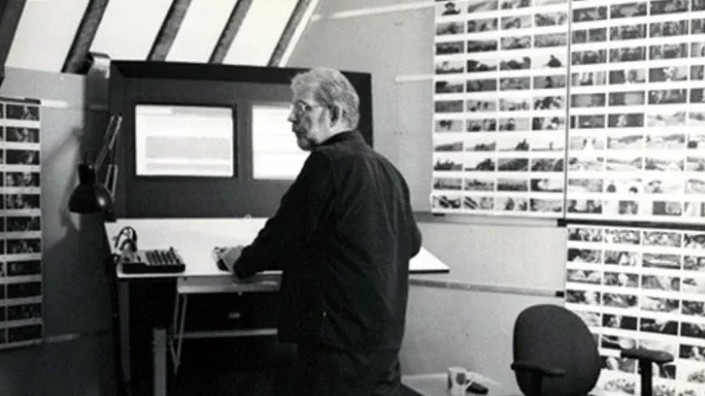
Walter Murch opened my ears to film
Michael Ondaatje’s book The Conversations: Walter Murch and the Art of Editing Film changed the way I listened to movies. It is a series of conversations with Walter Murch, the brilliant editor and sound designer whose work includes films by Francis Ford Coppola and George Lucas.
One of the examples that has stayed with me is Coppola’s 1974 film The Conversation.
The film begins high above San Francisco’s Union Square. Far below, a man and a woman walk through the crowd. Surveillance technicians are trying to capture what they are saying. Different microphones are positioned around the square. One is aimed from a distance. Others catch fragments as the couple moves from one listening area to another.
We do not simply hear a clean recording of their conversation. We hear the attempt to hear it.
Words emerge and disappear. Background noise gets in the way. The sound distorts. Pieces recorded from different positions have to be brought together. The meaning seems to change according to what can be heard, what cannot be heard and where the emphasis falls.
The camera shows us the square, but the sound tells us how to experience it.
That scene opened my ears to something important: the placement of a microphone is a storytelling decision. Where we listen from matters just as much as where we look from.
Audio does more than accompany the picture
We often speak about sound as though it is something added to a finished image. Get the cameras in place, capture the video and then make sure the sound is acceptable.
But sound is not merely there to support the picture.
Sound tells us where we are. It tells us what is close, what is far away and what may be approaching from somewhere outside the frame. It carries the texture of a voice, the breath before a song, the reaction of a room and the silence that follows something important.
Most of all, sound carries character.
You can learn a surprising amount about someone without seeing their face. You hear confidence, hesitation, humour, kindness, weariness and joy. You hear the difference between a performer singing the notes and a performer meaning them.
When the sound is good, our imagination joins the production. We begin to create the pictures ourselves.
What do people actually tolerate?
Viewers will forgive an imperfect picture. They will watch something grainy, dimly lit or even temporarily frozen if they can still hear what is happening.
The reverse is much harder.
A beautiful image with muffled voices, distortion, dropouts or music that hurts the ears becomes exhausting very quickly. We may keep looking for a few moments, but the connection has already been damaged. If we cannot understand the words or feel the music, we stop participating.
This matters for independent creators and small community events because bandwidth is not unlimited and neither are production budgets. A live broadcast from a theatre, community hall, festival field or island venue may not have the pristine Internet connection of a major studio.
So what do we protect first?
The audio.
Everyone does not need to become a television network
There is enormous pressure now to make everything look like television. Multiple cameras. Perfect lighting. Constant movement. High resolution. Graphics flying in from every direction.
Those things can be wonderful when they serve the event. They can also become barriers. A musician may decide not to broadcast because there are not enough cameras. A community organizer may assume a small event is not worth sharing because it will not look polished enough. A creator may spend so much time trying to manufacture a picture that the actual human exchange gets lost.
Character Driven was never meant to make ordinary people imitate a television network.
It is meant to help people share what is happening where they are. A performance. A conversation. A local event. A voice from a place someone else cannot reach in person.
Sometimes video will be part of that. Sometimes the video will be simple. Sometimes a still image, a few photographs or no picture at all may be the most sensible choice.
That is not a failed broadcast.
Radio was never failed television.
The desert-island test
The desert island is imaginary, of course, but the choice is real.
If I have limited Wi-Fi, limited equipment or only one opportunity to get something right, I want to capture the part that carries the story. I want the microphone close enough to hear the voice clearly. I want the music to have warmth and room to breathe. I want the person listening somewhere else to feel that they have been invited in.
If the picture is modest, we can live with that.
If there is no picture, the listener’s imagination can supply one.
But if the sound is painful, unintelligible or missing altogether, the heart of the event may be lost.
George Lucas and Walter Murch helped change the way modern films sound because they understood that audio is not an afterthought. Long before MTV, radio stations, records and live broadcasts proved the same thing in another way. We do not need to choose between audio and video when both are possible. We simply need to remember which one must not be sacrificed when they are not.
If I were broadcasting from a desert island, I would choose great audio with no video over good video with crappy sound.
Because video may show people where I am.
Sound can make them feel that they are there with me.
References and further reading
- Michael Ondaatje, The Conversations: Walter Murch and the Art of Editing Film.
- Francis Ford Coppola, The Conversation (1974), edited and sound-designed by Walter Murch.
- Walter Murch, In the Blink of an Eye: A Perspective on Film Editing.
Leave a Reply