
When Great Live Music Isn’t Enough
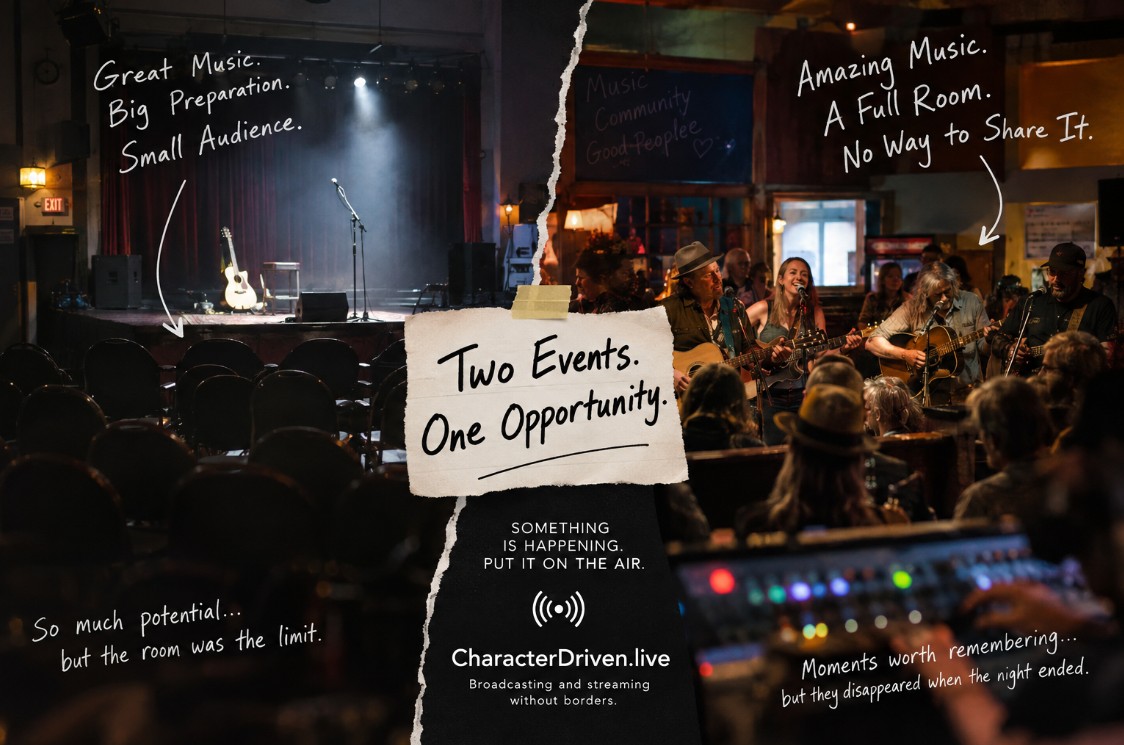
Within a few days of each other, we watched two very different live music events.
Both had terrific musicians.
Both had people working hard behind the scenes.
Both created moments worth hearing.
And both left enormous opportunities on the table.
One was a carefully planned, ticketed concert with professional sound, merchandise, live audio streaming, multitrack recording and some video.
The other was a busy community music night, packed with performers and people enjoying themselves, with a sound person keeping the stage moving and audience members occasionally pulling out their phones to capture something memorable.
One had too few people in the room.
The other had plenty of people in the room, but almost nobody outside it could participate.
These may sound like opposite problems.
They aren’t.
In both cases, the event depended too heavily on the people physically standing inside the building.
Event One: Everything Was Ready Except the Audience
Consider a ticketed concert.
The musicians have prepared. A theatre has been booked. There is professional sound. Merchandise is available. The performance is being recorded. Someone is even handling a live audio broadcast.
On paper, it looks as though everything has been covered.
But attendance is disappointing.
At $25 a ticket, someone who is curious about the band has to make a fairly substantial commitment before experiencing the show. Someone living elsewhere can’t attend at all.
Meanwhile, the people producing the event are juggling sound, recording, streaming, merchandise, doors and all the other details involved in putting on a show.
Then small event-management decisions begin having surprisingly large consequences.
Perhaps a theatrical effect such as a smoke or haze machine bothers some audience members. Someone leaves early, but nobody asks why.
Perhaps the venue has particular rules that aren’t being followed during intermission.
Perhaps the audience disperses during the break and some never return.
Perhaps the musicians themselves later feel that they weren’t sufficiently rehearsed.
None of these things necessarily destroys an event.
Together, however, they can determine whether an evening feels successful.
And technology alone doesn’t solve them.
Good broadcasting begins with good event management.
Don’t Let the Intermission Become Dead Air
An intermission doesn’t have to mean that everything stops.
It can be one of the most valuable parts of the evening.
Talk to a musician. Interview the organizer. Introduce the merchandise. Invite people to send a heart or a tip. Ask the audience what they’re enjoying. Preview the second half. Let someone watching remotely send a question.
Give the people in the building something to participate in rather than simply releasing everyone for twenty minutes and hoping they come back.
This also creates an opportunity to notice what’s happening.
If several people are leaving, someone can simply say:
“Sorry to see you go. Was everything okay?”
That isn’t market research. It’s hospitality.
And occasionally the answer will reveal something the organizer desperately needs to know.
“The sound was too loud.”
“The smoke was bothering me.”
“I couldn’t see.”
“I didn’t realize there was another set.”
“I have to catch the ferry.”
Now the organizer has information rather than assumptions.
Event Two: A Wonderful Night Nobody Else Could Hear
Now consider the opposite situation.
It’s a regular community music night.
The room is busy. Musicians keep appearing. Some performances are extraordinary. People are photographing and recording snippets because they want to remember what they’re hearing.
The problem isn’t getting people into the room.
The problem is that the experience stops at the walls.
Someone hears an amazing performer and texts a friend:
“You should hear this.”
But the friend can’t.
There is no live link to send them.
Tomorrow there may be a few photographs and phone videos, but tonight’s event itself is disappearing as it happens.
That’s a very different kind of lost opportunity.
It Doesn’t Need a Television Crew
This is where we think differently about broadcasting.
A live community event doesn’t necessarily need cameras, a director, a truck full of equipment and somebody sitting behind six monitors.
Sometimes it needs a cable.
If there is already a sound system operating in the room, an appropriate audio feed can be connected to a simple broadcasting setup.
The sound person can continue being the sound person.
Someone else can be the on-location host.
And the person managing the actual broadcast doesn’t necessarily have to be in the building at all.
A producer could be sitting across town, across the province or across the country.
The host concentrates on the room.
The sound person concentrates on the sound.
The producer concentrates on the broadcast.
And suddenly a local event has another room.
The online room.
“You Have to Hear This”
Imagine being at a community music night and hearing somebody extraordinary.
Instead of recording 30 seconds on your phone and posting it tomorrow, you send your friend a link:
We’re live. Listen to this.
A QR code in the venue can do the same thing.
Someone arriving at the event can scan it, share the live page and bring somebody else into the experience.
That remote listener can participate too.
They can send a heart.
They can share the event.
They can tip.
They can come back next week.
A person who discovered a local performer from 3,000 kilometres away has become part of a community they couldn’t physically enter.
That’s when a local event stops being limited by geography.
And Then There Are the Tips
Live events cost money.
Musicians need support. Organizers need support. Venues need support. Sometimes the person helping in the kitchen or behind the bar is volunteering because there simply isn’t enough money to pay another employee.
Yet an appreciative audience is already sitting there.
And potentially, another audience is listening elsewhere.
Why wait until someone buys a T-shirt?
A live event can provide opportunities to support the people making the evening possible while the audience is actually experiencing its value.
The organizer can decide how those proceeds are distributed. They might support performers, production costs, volunteers or venue staff.
The important point is simpler:
Appreciation can become participation.
People who cannot afford a large contribution can still send a heart or share the event. Someone who has just heard an astonishing performance might choose to send $5, $10 or $20.
Instead of asking only, “How many tickets did we sell?” an organizer can begin asking:
How many people did this event reach, engage and inspire to support it?
Capture What You’ve Already Created
There is another cost that event organizers rarely put in their budgets.
Lost media.
A remarkable performance happens once.
If nobody records it properly, it is gone.
A live broadcast can also become the beginning of an archive.
Audio can be preserved. Photographs can be gathered. Short video clips can document the evening. Interviews can become future promotional material. A great performance tonight can help promote next month’s event.
You don’t necessarily need to create more content.
You need to stop throwing away the content you’re already creating.
The Technology Is Only Half the Answer
We’ve become convinced that successful community broadcasting isn’t simply about supplying technology.
It’s also about helping organizers think through the event itself.
Who welcomes the audience?
Who watches the doors?
Who notices when people leave?
What happens during intermission?
Where can people smoke without affecting the venue or other guests?
Could smoke or haze effects cause accessibility or health concerns for audience members?
Who handles merchandise?
Who talks to the online audience?
Who captures photographs?
Who records the performance?
Who is responsible for the broadcast?
And most importantly:
Does everybody know their job before the doors open?
These aren’t glamorous questions.
They’re the questions that can save an event.
Two Events. One Opportunity.
Our two events couldn’t have looked more different.
One had sophisticated production but struggled to fill the room.
The other had a thriving room but almost no way to share what was happening beyond it.
One captured much of its performance for posterity.
The other allowed much of a wonderful evening to disappear.
Neither fully captured the opportunity for audience participation and direct support.
That’s the gap we’re interested in.
CharacterDriven isn’t about replacing the physical event with the Internet.
Quite the opposite.
It’s about making the physical event more valuable.
Keep the room.
Keep the stage.
Keep the musicians, volunteers, strange little venues, busy kitchens, community organizers and people bumping into neighbours they haven’t seen for six months.
Then open another door.
A door that doesn’t lead outside.
It leads everywhere.
Something Is Happening. Put It on the Air.
CharacterDriven.live is being built around a very simple idea:
If something worth experiencing is happening where you are, broadcasting it shouldn’t require a broadcasting company.
Connect your audio.
Put out a microphone.
Have someone host.
Bring in a remote producer if you need one.
Invite the audience.
And go live.
Your event is still local.
Your audience doesn’t have to be.
Something is happening. Put it on the air.
CharacterDriven.live
Broadcasting and streaming without borders.
Leave a Reply